Miriam Jessett
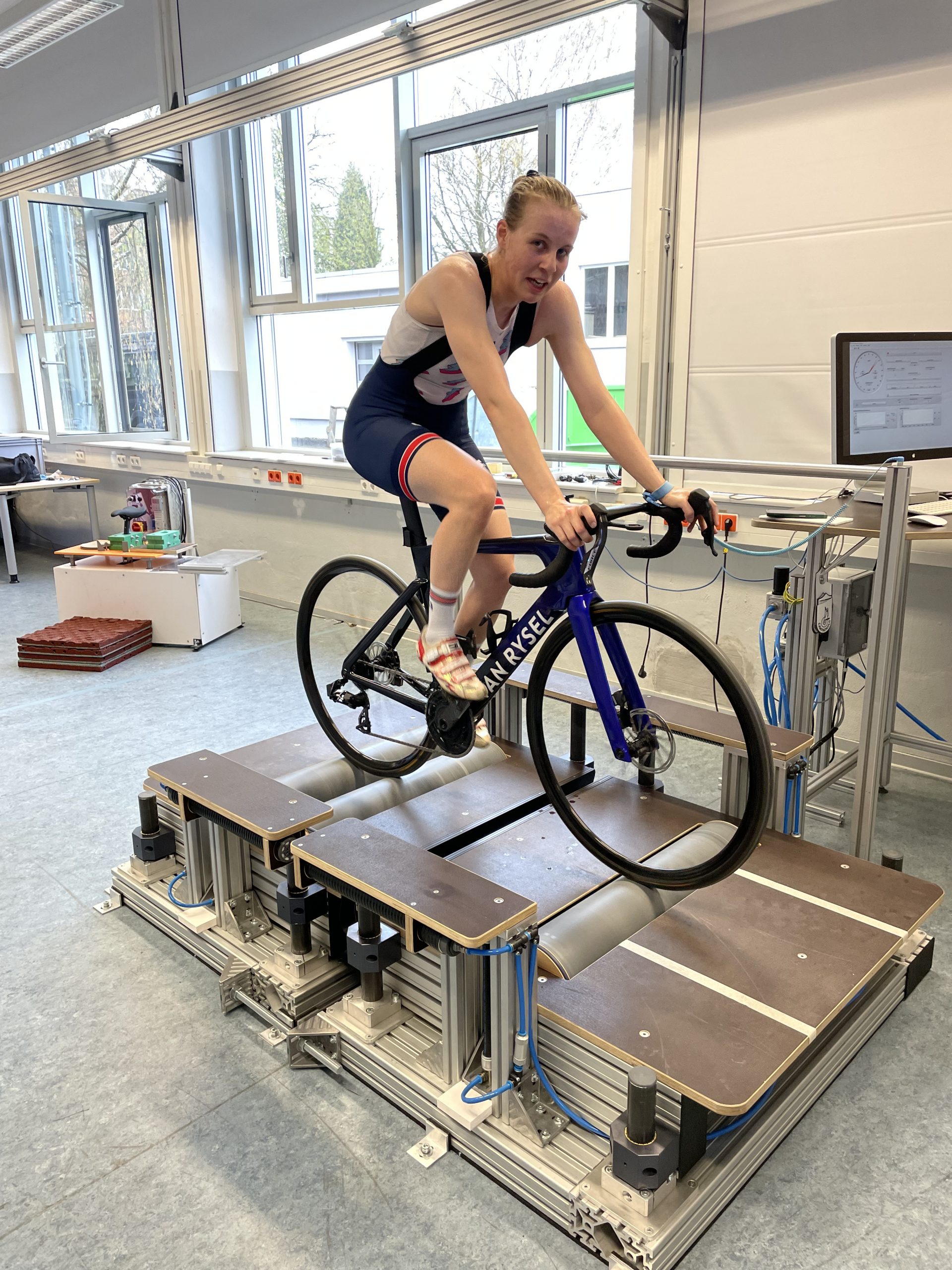
The ISEA Student Engagement Award funding was used to support a research trip to Chemnitz University of Technology, Germany, for my Sports Engineering Masters project. The grant covered travel and accommodation costs for the duration of the visit, enabling access to the p.a.v.e dynamic treadmill. This is a highly specialised piece of equipment that was essential to the data collection phase of my research. Without this support, the visit would not have been financially viable. The funding played an important role in making this research possible.
During the visit, data collection was completed with a cohort of trained cyclists using the p.a.v.e. laboratory treadmill. Participants completed a Conconi step pre-test to establish individualised anaerobic threshold values, followed by an ABA main trial comparing physiological responses to vibration and no vibration conditions at a constant target velocity. Heart rate and power output were recorded continuously across all conditions, generating a comprehensive dataset for analysis. Working directly alongside Professor Jens Buder and Dr Stefan Schwanitz provided an invaluable opportunity to develop practical skills in laboratory testing, data acquisition, and experimental protocol management within a world-class research environment. The collaboration also offered significant professional development, exposing me to the standards and practices of an active research group with an established publication record in cycling biomechanics and sports equipment testing.
The primary output of the visit is a dataset capturing the physiological responses of trained cyclists to surface-induced vibration under controlled laboratory conditions. This data forms the foundation of my master’s dissertation, which investigates the relationship between vibrational exposure and cycling fatigue. The study also resulted in a standardized testing protocol for assessing vibrational exposure and physiological strain on the p.a.v.e. system.
Following the data collection visit, the focus of the project now shifts to data processing and analysis. Heart rate and power output data will be analysed across the surface conditions to identify statistically significant differences between vibration and no vibration states. The aim of which is to quantify the physiological cost of vibration exposure during cycling. Findings will be contextualised within the existing literature on cycling fatigue, vibration transmission, and equipment optimisation. The completed analysis will be written as a full master’s dissertation. I am keen to explore how the findings might inform tyre and equipment set-up recommendations for competitive cyclists, particularly those competing on mixed or rough surface terrain.